Who it serves
Rosetta is currently designed for the Salesforce delivery professional — but "delivery" is a relay, and the baton passes through three different pairs of hands. The seller — the Account Executive or Solution Engineer — carries the architecture story that wins the deal. The contracting seller — Salesforce Professional Services or a Global Systems Integrator partner — sells the delivery itself. And the delivery team — a ProfServ or GSI crew that today is an increasingly small human core working alongside agents — executes it. Different jobs, different vocabularies, one shared problem: the confidence these projects run on lives in a small number of expert heads, and it does not travel. When the right expert is in the room, the engagement moves. When that expert is booked, promoted, or on another continent, the engagement runs on whatever the people present can reconstruct — and reconstruction is where projects die.
What follows is what that problem looks like from inside each pair of hands, and what changes when the engagement's knowledge is carried by a governed system instead of a calendar.
The seller — the AE as much as the SE
Before. The Solution Engineer's discovery call goes well, and all of it lands in a slide deck — where it dies. Three weeks later a different colleague retells the architecture story from memory, a little differently. And the Account Executive has it worse: selling the data foundation means explaining architecture they never signed up to learn, so many quietly don't — and the deal goes out without the foundation the agent will eventually need. The customer discovers that in month six, as a change order.
After. Discovery lands in a living engagement model, and the architecture story comes out of it ready to carry: why this customer needs the data foundation, what to build on it, and the evidence behind both — in the customer's own language. The SE walks into every call with the accumulated, governed context of the whole engagement. The AE carries a confident architecture story without having to become an architect — which is precisely the point: the knowledge travels to the sellers who would never have gone to it.
The contracting seller — Professional Services or the GSI
Before. Whoever sells the delivery — Salesforce Professional Services or a GSI partner — builds the Statement of Work by hand, one engagement at a time, from whatever survived pre-sales: slideware, recollections, optimism. Scope is estimated from experience rather than evidence, the telephone game between the sales team and the contracting team loses another round of fidelity, and the SOW — the document that is, in effect, a contractual statement of what will be built — inherits every gap.
After. The SOW derives from the same governed engagement model the seller used, so what was promised and what is contracted are the same thing: deliverables trace to stated outcomes, acceptance criteria come from evidence, and the negotiated commercial terms stay human-owned while the scope stays graph-grounded. The organization selling the delivery prices what the model actually shows — not what the deck implied.
The delivery team — a human core, working with agents
Before. The delivery crew inherits a won deal and an org they have never seen, and re-derives the architecture from scratch: weeks of spelunking through metadata, interviews to recover decisions someone already made, anti-patterns discovered the expensive way — in production. Delivery quality varies decisively with the staffing spreadsheet, and the practice's best thinking walks out the door with every departure.
After. The team inherits the engagement model itself, compiled into a concrete, governed delivery plan that both humans and agents execute. That matters because the delivery team is changing shape: agents are compressing the work, and the human core is getting smaller — which makes the knowledge those humans carry more load-bearing, not less. Decisions arrive with their reasons attached, anti-pattern guidance lands before the build, and each engagement's lessons feed back into the shared body of knowledge under review, so the practice compounds instead of resetting. Salesforce's Forward Deployed Engineers slot into exactly this seam — the accelerant that gets a delivery team started fast, carrying the same governed knowledge the team will run on.
A compass, a map, and a Geiger counter
The three vignettes add up to three instruments that every one of these roles carries into every conversation. A compass: where this engagement should go, grounded in what the business actually said it wants. A map: how to get there — the evidence-based plan, with the decisions already made and their reasons attached. And a Geiger counter: the anti-patterns that click before you step on them — the accumulated warnings of everyone who stepped there first. In one early working session, an operator asked Rosetta a question with an anti-pattern embedded in it — one they did not know was an anti-pattern. Rosetta caught it.
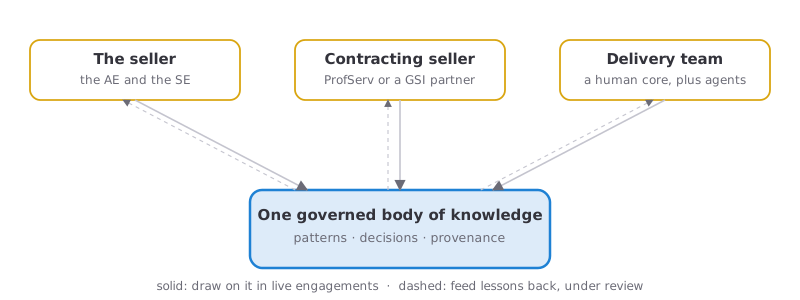
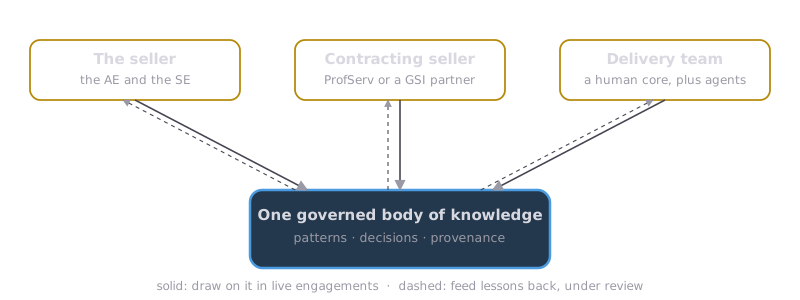
The seller, the contracting seller, and the delivery team draw on the same governed body of knowledge — patterns, decisions, provenance — each in the language their conversation needs: outcomes for the executive, trade-offs for the architect, configuration for the builder. The baton passes, and the knowledge passes with it, so continuity stops depending on the staffing calendar. The expertise still comes from experts — Rosetta sits on the shoulder of every practitioner and closes the gap between the average engagement and the best one.
How that actually works is the subject of the concepts tour — or start from the overview.