The ten-minute tour
One engagement, start to finish — with the real artifacts.
About this engagement
Northern Trail Outfitters (NTO) is Salesforce's fictional outdoor retailer, and this is a demonstration engagement built on simulated data. Every excerpt below is taken verbatim from the actual artifacts Rosetta produced for it — and Rosetta's own provenance system labels the content exactly as what it is: simulated, pending ratification. Showing you honestly labeled artifacts is the product working.
The setup. NTO wants Customer 360 and CDP value: unified customer profiles, a loyalty-aware marketing journey, and an Agentforce service agent that deflects routine cases. Their data lives in five places — CRM, Demandware commerce, point-of-sale, a Snowflake lake, and a loyalty program — and, as it turns out, it is too fragmented and too unreliable for default matching. Sound familiar? Now watch what happens to that discovery material.
Stop 1 — Discovery goes in
Discovery conversations, stakeholder interviews, and forensic data profiling enter the engagement. Nothing dies in a slide deck: what the business said it wants, what actually exists in the org, and what the data profiling found (placeholder email families, weak phone distinctness, a large fraction of transactions not linkable to any customer) all land as structured, sourced entries.
Stop 2 — The digital twin takes shape
The digital twin holds the engagement's knowledge as a living model. Here is one of its four context artifacts — the Agentforce deflection artifact — exactly as it exists in the graph, three layers deep:
Intent: "Deliver 24/7 case deflection for common inquiries via an Agentforce service agent. Agent must correctly identify the customer, retrieve accurate order/case/profile context … and escalate complex or high-value cases to humans with pre-contextualized information."
Structure: "Read-paths only in scope for v1 … Write-paths: case creation only — agent does not mutate Contact, Order, or Account. Escalation rule: if identity confidence < high OR order status unavailable within 2s … hand off to human."
Confidence:
medium· Review status:draftContradiction (tracked, not hidden): "Real-time order-status requirement vs POS nightly + Demandware hourly freshness — resolved by scoping v1 to Demandware orders only; POS orders deferred until freshness uplift."
Notice what's first-class here: a confidence level, a review status, and a named contradiction with its resolution. A thin or conflicted twin produces an honest plan, not a confident hallucination.
Stop 3 — Decisions carry their reasons; gaps get names
Every consequential choice is recorded as a decision trace at the moment it is made. The identity-resolution decision, verbatim — first as the leadership gloss, then one of its machine-checkable guardrails:
"Match customers only on identifiers we have verified are reliable — anchored on the loyalty ID, with email and phone admitted only after they pass placeholder and uniqueness checks."
Must NOT use Name alone as a match key. Must NOT count a transaction toward lifetime value unless it resolves to a Contact via at least one Tier-1 or two corroborating Tier-2 identifiers.
Unknowns stay visible too: the middleware layer for real-time order fetch is unconfirmed, so it exists as a named gap the plan must close — not a silence someone discovers in week nine.
Stop 4 — The Spec Manifest compiles
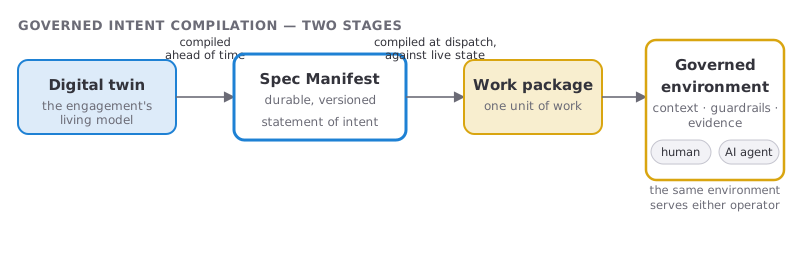
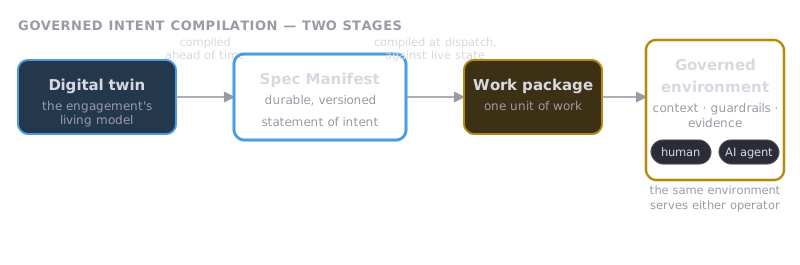
From the twin, Rosetta compiles the Spec Manifest — the delivery plan humans and agents execute. For NTO: one wave, four epics, four sprints, fourteen work packages, each carrying a plain-English purpose, its context bundle, and its gates. The manifest binds commitments, not suggestions — for example:
MUST — strict transaction-to-Contact linkage before lifetime value. No transaction participates in lifetime-value or tier-classification segmentation unless it resolves via Tier-1 or two corroborating Tier-2 identifiers; unlinked transactions are held in a guest-recovery queue. Acceptance evidence: the calculated-insight surface refuses to compute LTV for any cohort whose resolved-linkage rate falls below the floor.
Stop 5 — The documents render for each pair of hands
From the same graph state, the Engagement Codex renders the three documents — the Solution Thesis for the seller, the SOW for the contracting organization, the manifest for the delivery team — each in its audience's language. The same thesis also renders in a leadership tone for the decision room, and that rendering opens with the decision, not the plumbing:
"Authorize a bounded Customer 360 / CDP proof-of-value, scoped to a single authenticated-customer subset anchored on Loyalty ID … Withhold full production activation until the named data, identity, governance, and latency gaps are closed."
Verdict: Conditionally Ready for a bounded POV; not for full production activation until the gap list closes. … "The verdict is therefore not a hedge; it is the contract NTO needs from its solution architect."
An eleven-dimension readiness scorecard sits behind that verdict, and one of its rows says Not Met out loud — evidence quality, with its remediation path named. A system that will tell a customer "not met" is a system whose "ready" means something.
Stop 6 — Governed work dispatches
Each work package compiles at dispatch into a governed working environment — the right context, the applicable decision guardrails, the evidence — for whichever operator picks it up, human or AI agent. This is where the guardrails earn their keep: when an implementing agent proposes to improvise around a governed decision, the ADR refuses it. And when an operator's own question embeds an anti-pattern — one they don't know is an anti-pattern — the guardrails surface that too.
Stop 7 — Provenance, gates, and the human signature
Nothing in this tour silently became load-bearing. Every entry carries its origin — verified evidence, human judgment, or machine inference, kept distinct. Simulated content is stamped simulated until a human ratifies it through a recorded gate. When a trust review asks who authorized this action, over which data, under which policy, the answer is a lookup, not an archaeology project.
What you just watched: discovery material became a governed model; the model compiled into a plan; the plan rendered as three documents for three audiences; the work dispatched into governed environments; and every step left an auditable trail. When the twin changes, all of it re-renders — no one hand-edits a stale copy.
Want this for a real engagement? Access is self-service — register at rosetta-design.com and follow the install guide — or start with how it works.