The digital twin
When you arrive at a hospital, nobody asks whichever clinician happens to be on shift to remember your history. There is a chart: allergies, medications, what was tried, what was ruled out, which results are still pending. The chart is why your care can change hands — between shifts, departments, even hospitals — without you starting over from the beginning, and without anything important depending on one person's memory.
Enterprise delivery mostly runs without a chart. Every engagement accumulates knowledge: what the customer wants and why, what already exists in their systems, what was decided and for what reasons, what was considered and rejected, and what nobody knows yet. Today that knowledge scatters — a goal stated in a kickoff deck, a constraint buried in a note file, a decision made in a chat thread, a caveat living in one architect's head. When the engagement changes hands, whoever picks it up reconstructs the history from fragments. When people leave, the parts only they knew leave with them.
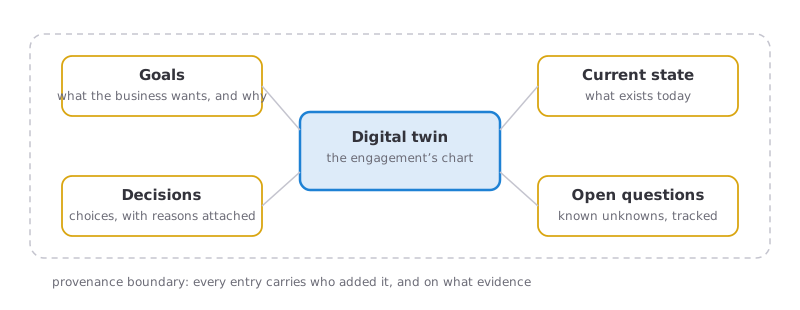
The digital twin is that knowledge kept as the chart instead: a living, structured model of the engagement. Not a document that summarizes the engagement at one moment, but a model that is the engagement's current state of knowledge — updated as the work proceeds, readable by anyone who joins, and never dependent on who happens to be in the room.
What the twin holds
In plain terms, four kinds of things:
- The goals. What the business has actually said it wants, and why — not a paraphrase of it three retellings later.
- The current state. What exists in the customer's environment today: the systems, the data, the constraints the work must respect.
- The decisions. What was decided, with the reasons attached — and what was ruled out, so the same dead end is not explored twice.
- The open questions. What remains unknown, tracked explicitly as part of the model rather than silently forgotten. An unanswered question in the twin is a visible item with a name, not a gap someone discovers in week nine.
Every entry also carries who added it and on what evidence — the provenance discipline described in Governance as trust.
Why it matters
The twin is not a filing system; it is the compiler's input. In governed intent compilation, the Spec Manifest — the governed plan that travels from executive conversation to production configuration — is compiled from the twin. The plan can only be as good as the model it is compiled from, and that is precisely the point: because open questions are first-class entries rather than omissions, a thin twin produces an honest, thin plan that says what is still unknown — not a confident hallucination that papers over the gaps. The quality of the model and the quality of the plan are visibly, checkably connected.
That is the difference between tribal knowledge and an asset. Tribal knowledge walks out the door; a twin compounds — every conversation, decision, and discovery makes the model, and therefore every plan compiled from it, better.
Terms used across these pages are collected in the plain-English glossary.