Virtual Employee Economics
Every other page in this section asks whether governed delivery works. This one asks what it costs — and what happens to the economics of delivery when a "worker" can be a person or an AI agent, interchangeably. The research program calls an AI agent engaged this way a virtual employee (VE): not a tool a person operates, but a unit of labor that takes on work a person would otherwise do. Once that substitution is possible at all, delivery leaders face a labor market with two kinds of workers whose costs and capabilities move on very different curves. The Three Laws of Virtual Employee Economics — developed by Vernon Keenan of Keenan Vision, in a research partnership with UC Berkeley's Haas School of Business — describe those curves.
The Three Laws
Law 1 — Infinite Scale. VE adoption follows a logistic curve: slow at first, then steep, then saturating at whatever ceiling a given market can carry. For a delivery leader the plain meaning is that workforce capacity stops being bound by hiring. Human capacity grows one recruit, one ramp-up at a time; VE capacity, once adoption inflects, grows faster than any org chart can — until it hits the market's carrying capacity, not yours.
Law 2 — Cognitive Commoditization. The cost of a unit of cognitive work decays exponentially over time. Anything priced on the scarcity of a skill — analysis, configuration, documentation, first-draft anything — sits on a falling price curve. Margins built on charging for scarce cognition erode on a schedule set by the decay rate, not by competitive pressure.
Law 3 — Exponential Learning. VE performance rises with adoption: the more the virtual workforce is used, the better it performs. Human teams improve too, but each new hire starts near zero; a VE workforce's gains accrue to every instance at once. Capability accrues with use.
The laws carry a corollary. The Gradient Value Corollary models the quiet erosion of employment tiers: displacement does not arrive as one dramatic event but diffuses gradually across the skill ladder, tier by tier, as VE competitiveness — performance over cost — climbs while both curves move in the VE's favor.
How to read the laws
The Three Laws are a formal model, not a measurement. They are delivered as an interactive, parameter-driven application — adoption rates, cost-decay constants, and learning slopes are sliders to explore, not measured constants of nature. The instrument here is mathematics: the laws tell you what follows if the curves hold, and the research program's job is to estimate where, and how fast, they do. That is a weaker claim than field data — and a stated one.
Why this matters for Rosetta
If the boundary between human and machine labor is going to move — and the laws say it moves continuously, not once — then the economically decisive question is what happens to work when it crosses. Work that was briefed to a specific person, or wired into a specific tool, must be re-explained, re-scoped, and re-trusted on the far side. Work that was compiled for a worker crosses intact.
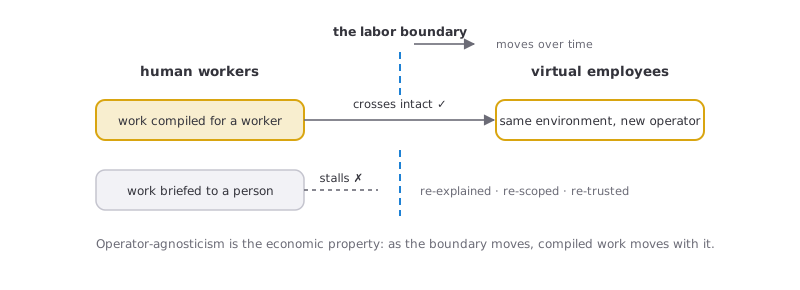
That operator-agnosticism is the core design property of governed intent compilation, and Virtual Employee Economics is the argument that it is not a convenience but the economically load-bearing property of the whole system.
The Cognitive DevOps Maturity Model working paper (first draft, June 2026) states this as a named hypothesis — VE Economics: the Spec Manifest is a unit of economic production, not just an engineering artifact. In plain terms — our reading, not the paper's — it is the thing an organization prices, allocates, and reassigns as the labor boundary shifts. The hypothesis is presented as a hypothesis, awaiting validation, and this site treats it as one.
The honest counterweight: Quiet Erosion
The same paper names the risk on the other side of the ledger — Quiet Erosion: organizations that delegate cognitive work may gradually lose the capacity to supervise the very systems they delegate to. (The corollary above uses the same phrase for employment tiers; this is the organizational version — erosion of oversight, not of jobs.) The research program treats this as a named risk with a validation agenda, not a footnote. And governance is the designed mitigation: delegation with recorded, inspectable reasoning — provenance, decision traces, an auditable trail — rather than delegation into a black box.
The Three Laws are Keenan Vision research, delivered as the interactive model described above; the Cognitive DevOps Maturity Model paper behind the VE Economics and Quiet Erosion hypotheses is summarized in the research papers; the Rosetta story starts at the overview.