The big idea: compiling intent
There are two ways to build a house. In one, the architect draws a blueprint — a precise, agreed document that every trade works from, and that an inspector can check the work against. In the other, the architect describes the vision aloud at the kickoff and hopes. The framers remember it one way, the electricians another, and by the time the drywall goes up, the house being built is nobody's vision in particular. Enterprise software solved this problem for machines long ago with the compiler: write the instructions once, precisely, and translate them mechanically — faithfully, repeatably — into what the machine executes. Enterprise delivery still runs on the second method: the vision described aloud, rebuilt from memory at every handoff.
Rosetta's founding idea is to close that gap with a discipline we call governed intent compilation. It borrows the compiler's shape, then makes one inversion: a classical compiler targets a machine; this discipline targets a worker. What comes out the far end is not code. It is a governed working environment that a person — or an AI agent — steps into, with the right context, the applicable guardrails, and the supporting evidence already assembled. The worker arrives to find the job set up the way a master craftsman would have set it up, every time.
Two stages, plain and simple
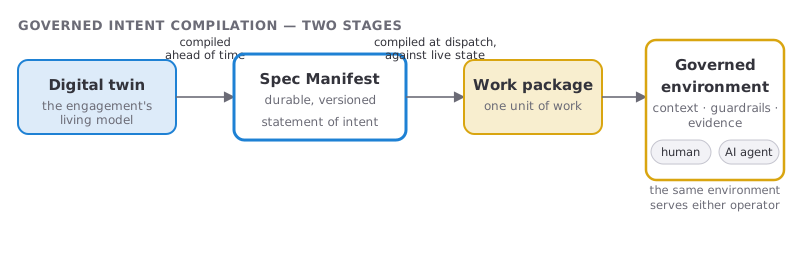
The compilation happens in two stages. Ahead of time, the engagement's living model — its digital twin, the accumulated picture of what this customer's business wants and why — is compiled into the Spec Manifest: a durable, versioned statement of the business's intent. This is the blueprint. It is drawn once per goal, agreed, and kept.
Then, at the moment work is actually dispatched, the second stage runs. Each individual work package is compiled fresh, against live conditions — the current state of the systems, the decisions ratified since the blueprint was drawn. Think of a chef working from a fixed menu but preparing each plate to order, rather than plating everything at dawn and serving it cold at dinner. The menu is stable; the plate is made for the moment it is served.
One environment, any worker
The same compiled environment serves a human engineer today and a virtual employee tomorrow. That is not a convenience; it is the property enterprises will need most as the boundary between human and machine labor moves. Work that is compiled for a worker — rather than hand-briefed to a specific person or hard-wired into a specific tool — can shift across that boundary without being re-explained, re-scoped, or re-trusted from scratch.
Why governance, not guarantees
There is one honest caveat. A traditional compiler can guarantee its output means what the input meant, because both ends are formal. Here, the inputs are authored by humans and by probabilistic AI, so that guarantee is not available — and in its place stands governance: provenance, decision traces, and a maturity ladder that let you trust what you cannot formally prove.
Everything else on this site is a consequence of this one idea. The twin is what gets compiled; the manifest is the blueprint drawn along the way; the governed environment is what the worker steps into; governance is why the result can be trusted.
New to the vocabulary? The plain-English glossary defines every term on this page. To see what this means for your role, read who Rosetta serves.