rosetta-platform¶
This repository is where Rosetta's knowledge lives. Everything the system knows — and every rule about how that knowledge earns trust — originates here: the graph schema that gives knowledge its shape, the curated Data 360 knowledge corpus itself, the engagement digital twins, the governance gates that promote content from proposed to validated, and the seven Claude Code / Cowork plugins practitioners use to work with all of it.
Everything downstream serves what this repository produces. The Go
app server behind api.rosetta-design.com, the MCP connector, and
the console all consume the schema and knowledge published from
here — that is the system's producer/consumer split, and this repo
is the producer. Nothing becomes part of Rosetta's canon except
through this repository's review gates.
Current release: v0.18.0, governed by semantic metamodel v1.11.0 (docs/rosetta-semantic-metamodel-v1.11.0.md). Published documentation lives at docs.rosetta-design.com. The rest of this page: the production architecture the system runs on, then the repository's contents for maintainers and contributors.
The production architecture on Google Cloud¶
Everything Rosetta serves runs on a deliberately small Google Cloud estate — two virtual machines, one public ingress rule, and no public SSH anywhere.
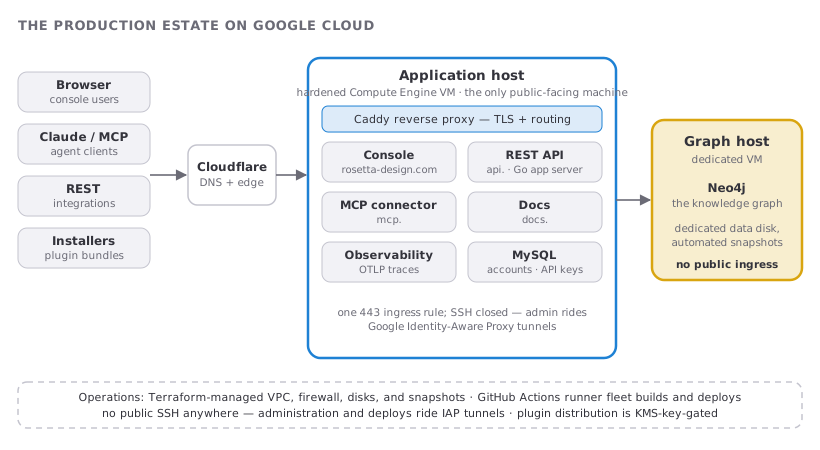
Every consumer — a browser on the console, a Claude session over the
MCP connector, a REST integration, a plugin installer — arrives
through Cloudflare and lands on the application host: a hardened
Compute Engine VM whose only public ingress is HTTPS. Behind its Caddy
reverse proxy live the enablement console
(rosetta-design.com), the Go app
server's REST API (api.), the MCP connector (mcp.), this
documentation site (docs.), OTLP observability, and the MySQL
database holding accounts and KMS-scoped API keys.
The knowledge graph itself — the asset all of this exists to serve — gets its own machine: a dedicated graph host running Neo4j on its own data disk with automated snapshots, reachable only over the private network. It has no public ingress at all.
The whole estate is Terraform-managed (VPC, firewall rules, disks,
snapshot schedules — declared in infra/ here and in the
consumer repo's infra/), built and deployed by a GitHub Actions
runner fleet, and administered exclusively through Google
Identity-Aware Proxy tunnels — SSH is closed to the internet on every
machine. Plugin and bundle distribution is gated by KMS-scoped API
keys rather than by network position.
What this repo is¶
This repository owns:
- Graph schema (
db/schema/) — 46 Cypher files declaring constraints, indexes, node-property contracts, relationship contracts, and the invariant gates. - Canonical seed content (
db/seeds/) — the Data 360 knowledge corpus as Cypher (03g–10g: vocabulary, semantic entities, platform objects, engine functions, business intents, context patterns, source artifacts, ADRs). Cypher is canonical; Markdown is a review projection (ADR-PL-001/005). - Engagement content (
db/engagements/) — engagement-scoped digital-twin Cypher produced by the archaeology pipeline. - Relational schema (
db/mysql/) — 26 idempotent SQL migrations applied viaschema_migrationstracking. - Plugin family (
util/plugins/) — seven Claude Code / Cowork plugins:rosetta-agent(the MCP tool surface),engagement-codex,engagement-rehearsal,engagement-authoring,rosetta-archaeology,rosetta-research, andd360-distiller. Distributed as a KMS-gated install bundle from rosetta-design.com — see INSTALL.md. - Operational scripts (
scripts/) — Bash + Node.js tooling invoked throughmake <target>, the canonical user-facing surface (ADR-PL-004). - Container orchestration (
docker-compose.yml,docker/) — Neo4j + MySQL + Phoenix services for local and CI-time stacks. - Infrastructure (
infra/) — Terraform for the GCP two-VM production topology. - Content authoring pipeline (
util/seed/) — the Markdown↔Cypher round-trip; Cypher is canonical, Markdown is the review surface.
The authoritative definition of every Work Packet, ADR, acceptance test, input set, and output path lives in docs/rosetta-platform.spec-manifest.md. The manifest is the single source of truth; this README is a navigational companion.
What this repo is not¶
- Not a Go application server. That is
rosetta-app-server. Per Constitution C-7 (ADR-PL-016), this repo produces and publishes; it does not import from or depend on consumers. - Not the admin console or KMS. The rosetta-design.com console
(key management, downloads, governance review UI) is
rosetta-enablement-agent. - Not the home of HTTP API specs, route handlers, or classification logic. Those belong with the consumer.
- Not the constellation governance layer. Cross-repo decisions
(
DT-RX-*/ADR-RX-*) live inrosetta-meta; this repo's governance series isADR-PL-*.
See manifest §2 for the full non-goals list.
Repo map¶
rosetta-platform/
├── db/
│   ├── schema/             # 46 Cypher files (constraints, contracts, gates)
│   ├── seeds/              # canonical D360 corpus (03g–10g)
│   ├── engagements/        # engagement-scoped twin Cypher
│   ├── mysql/              # 26 idempotent SQL migrations
│   ├── migrations/         # Cypher data backfills
│   └── backups/            # gitignored
├── scripts/                # neo4j/, mysql/, content/, docker/, release/, lib/
├── util/
│   ├── seed/               # Markdown↔Cypher round-trip pipeline
│   └── plugins/            # the seven-plugin family + marketplace.json
├── docker/                 # neo4j, mysql, phoenix service configs
├── infra/                  # Terraform GCP two-VM topology
├── contracts/              # app-server intake + install-bundle contracts
├── docs/
│   ├── adrs/               # 22 ADR-PL-* governing this repo
│   ├── decision-traces/    # DecisionTrace collection point
│   ├── runbooks/           # release-cut, production-deploy, content checklists
│   ├── workplans/          # per-WP working plans
│   ├── rosetta-platform.spec-manifest.md
│   └── rosetta-semantic-metamodel-v1.11.0.md
├── docker-compose.yml      # neo4j + mysql + phoenix (no app)
├── Makefile                # operational surface (C-4)
├── INSTALL.md              # end-user plugin install guide
└── CLAUDE.md, README.md, LICENSE
Quickstart¶
cp .env.example .env          # then edit credentials
make docker-up                # neo4j:5 + mysql:8.4 + phoenix
make db-init && make mysql-init   # apply schemas (idempotent, ADR-PL-002)
make db-seed                  # load the canonical seed corpus
make db-status                # verify counts
make db-invariants            # metamodel invariant gates
make d360-invariants          # the D360 contract gate
make help lists the full target index. Per ADR-PL-004, every
operation goes through a make target — no raw docker exec,
mysql -u, or cypher-shell in docs or runbooks.
Installing the plugins (end-user path) is a different flow — see
INSTALL.md: distribution is a KMS-gated bundle on
rosetta-design.com (plugin-install scope API key required).
Releases and publication¶
A release cut publishes two sibling artifacts under one vX.Y.Z tag
(runbook: docs/runbooks/release-cut.md):
- Consumer intake tarball (
make publish-for-app-server) — the schema+seed contractrosetta-app-serverandrosetta-enablement-agentpin (contracts/app-server-intake.md). - Install bundle (
make publish-install-bundle) — the KMS-gated end-user plugin bundle served from rosetta-design.com.
Documentation index¶
- docs.rosetta-design.com — the published constellation documentation site
- docs/rosetta-platform.spec-manifest.md — authoritative work definition
- docs/rosetta-semantic-metamodel-v1.11.0.md — the governing metamodel
- docs/adrs/ — the ADR-PL series (22 ADRs)
- docs/decision-traces/ — DecisionTrace record
- docs/runbooks/ — release-cut, production-deploy, content author/review checklists
- util/plugins/ — the plugin family (overview README)
- CLAUDE.md — agent session invariants
License¶
Proprietary work product of Keenan Vision, Inc. See LICENSE for the full notice. Use, reproduction, and distribution are governed solely by separate written agreement with Keenan Vision, Inc.
The license selection was ratified in docs/decision-traces/repo-license.md on 2026-04-26.